Where the Garden Still Speaks
- Beth Brubaker
- Jan 22
- 4 min read


Stewardship, Time, and the Beauty That Endures
What is planted in faith, tended with patience, and entrusted to time still finds its way to bloom.
Reading, writing, gardening, traveling—these are the pursuits that speak to me most clearly. Each, in its own way, connects me back to the natural world and reminds me to slow down and pay attention. Of course, faith and family hold the front row seats. They always have. Becoming a writer, then, feels less like a decision and more like a natural consequence of all that has been loved, tended, and quietly revered over time.
Celebrating sixty trips around the sun comes with a measure of experience—and, I hope, a touch of wisdom. At the very least, it offers perspective. When gathered, years have a way of revealing patterns: habits formed not by force, but by inclination. And habits, I’ve come to believe, often whisper where we are headed long before we arrive.
Recently, between writing sessions, research rabbit holes, and ordinary errands, I found myself with an unexpected hour to fill. No agenda. No clock watching. That small pocket of time carried me down a familiar road—one I’d only discovered last year, yet already felt tethered to. A path that leads not forward in any ambitious sense, but inward.
Gerbing Gardens is a quiet remnant of yesteryear tucked away as if by intention. Once part of a thriving nursery operation, it now stands as a living echo—stone walls softened by time, winding paths inviting unhurried steps, and trees that seem to remember who they were planted for. It is not manicured in the modern sense. It is kept—by memory, by patience, by the simple grace of being left enough alone to remain itself.
Walking there feels like stepping into a conversation already in progress. One carried by roots and light, by the silence that settles when something no longer needs to prove its worth. It is the kind of place that doesn’t ask much of you—only that you notice.
And perhaps that is why it beckoned me on that ordinary afternoon. A reminder that the most meaningful detours are often the quiet ones. The ones shaped by habit, reverence, and a life lived paying attention.
What remains difficult to comprehend, even while walking its quiet paths today, is the sheer ambition of what once stood here.
At its height, Gerbing Gardens unfolded as a living spectacle: 100,000 azaleas in bloom, joined by tens of thousands of Camellia japonicas, their glossy leaves catching winter light. An 800-foot camellia windbreak stood as both protection and proclamation. Beyond it, an amphitheater-shaped terrace, planted with 25,000 azaleas, as if nature itself had been invited to perform.
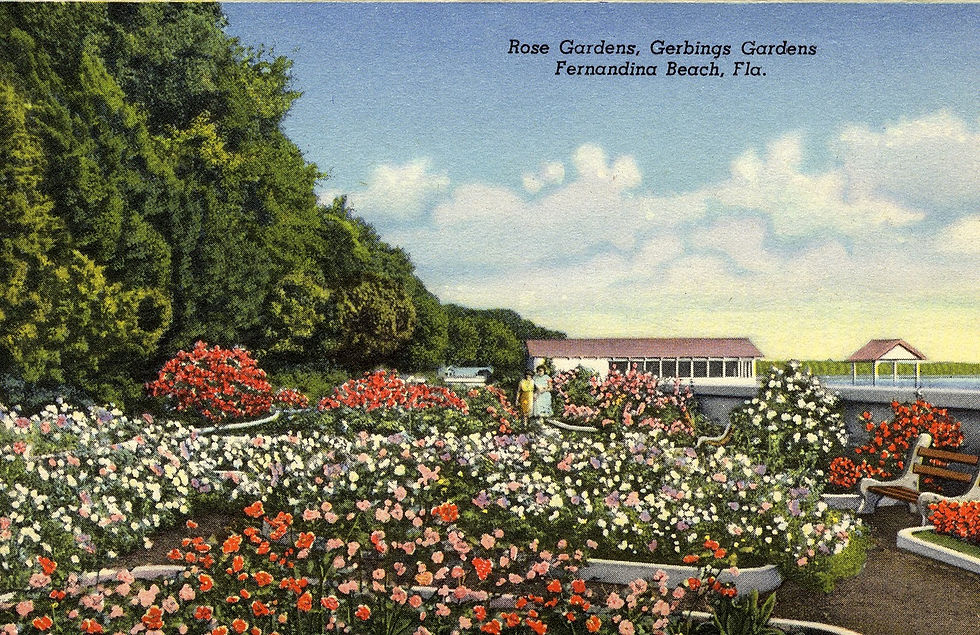
The return walk, nearly 1,800 feet long, was lined with dogwood, tung oil trees, redbud, and azaleas, a passage of color and texture that carried visitors slowly back through the garden’s embrace. At one time, the grounds also held a 4 acre sunken garden layered with azaleas, roses, annuals, perennials, and thousands of bulbs—each season planned, planted, and patiently awaited.
All of this existed against a backdrop that felt timeless: ageless live oaks draped in Spanish moss, southern magnolias, towering pines, red cedars, water oaks, bay trees, hickories, and countless others.
It is said that 15 years were required to create the gardens in their full appearance. A reminder that beauty of this magnitude is never rushed. The gardens were designed not only for wonder, but for welcome. Picnic areas invited lingering. Children’s playgrounds echoed with laughter. Camellias reached their peak from December through February, while azaleas took center stage March through April—all sheltered behind a 1,200-foot concrete seawall. Garden beds were defined by concrete curbing; chain-link fencing disappeared beneath Spanish moss and climbing vines. Broad walkways, known as “sawdust trails”, softened footsteps and slowed the pace.
For nearly twenty years, the gardens remained open to the public and hosted events such as the Festival of Flowers. Though never commercially successful, their influence endured. Gerbing and his business partner continued breeding and selling beloved cultivars, including Azalea indica ‘Mrs. G. G. Gerbing’ and Camellia sasanqua ‘Jean May’.
Today, the gardens live in quieter form. The current stewards have carefully removed vines and undergrowth, revealing mature azaleas and camellias long hidden beneath time. Vestiges of the original design remain: concrete curbing, garden beds, parking areas, and portions of the irrigation system. The original Gerbing greenhouse has been remodeled into a private building, while the sunken garden and rose garden have given way to homes. And yet, what was planted here does not disappear so easily.
There is still a sense, walking these paths, that the land remembers: beauty once tended leaves an imprint, habits of care, patience, and vision resonate long after the crowds have gone.
Perhaps that is why I find myself returning. Not to mourn what was lost, but to honor what endured.
Walking back through the gardens I was reminded that growth often happens quietly, unseen, long before it is revealed. What is planted in faith, tended with patience, and entrusted to time belongs not just to its maker, but to God. As a writer, I am drawn to places like this, where time layers meaning instead of erasing it, and beauty is shaped slowly by care rather than applause.
References:
Meyers, H. (2024, July 17). Following the legacy of Gus Gerbing. Amelia Island Museum of History, ameliamuseum.org/following-the-legacy-of-gus-gerbing/. Accessed 8 Jan. 2026.
Smithsonian Gardens. “Gerbing Gardens.” Smithsonian Gardens, gardens.si.edu/garden-story/gerbing-gardens/. Accessed 8 Jan. 2026.


Comments