Discernment in an Age of Information
- Beth Brubaker
- Jan 29
- 2 min read

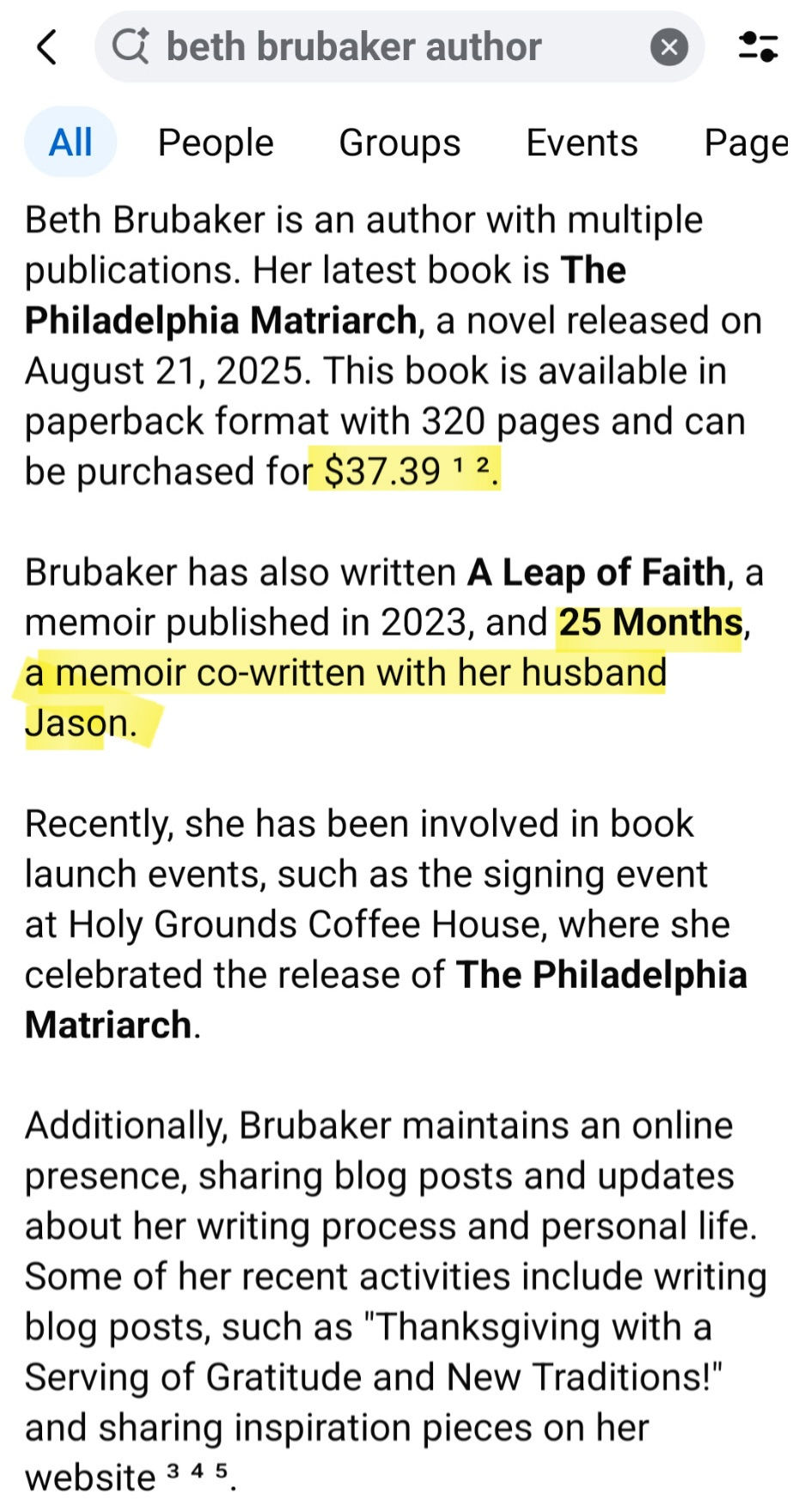
Recently, my husband Scott did a simple AI search using our names. What came back was… interesting.
Some of it was what you’d expect—public information, writing credits, familiar details. But mixed in were questionable facts and outright inaccuracies. One in particular made me laugh and pause at the same time: according to the internet, my book The Philadelphia Matriarch costs $37.39. It does not.
It’s available on Amazon for $19.99.
Then there was this gem: apparently, I wrote a book titled 25 Months, co-written with my husband, Jason.
For the record—Scott is my husband. I’ve never written a book called 25 Months. And while I admire doctors greatly, I am not Dr. Beth Brubaker. There is a Dr. Beth Brubaker who is an author. There is also another author named Beth Brubaker who co-wrote a book with her husband, Jason. That Beth is not me.
And this is where discernment comes in.
As a writer, I’m often asked about AI—how I feel about it, whether I use it, whether I fear it. My answer is usually honest and simple: I’m not sure yet. Time has a way of illuminating both the good and the bad in most things.
AI has been made out to be the big bad boogeyman lately, but then again, so was the printing press, the typewriter, the internet, and Google. Change is difficult for creatures of habit—especially when it arrives quickly and loudly.
The world we live in has always been a mixture of good and bad, truth and error, wisdom and noise. AI didn’t invent that—it just accelerated it.
The truth is, most of us have already used AI in one form or another. Search engines, autofill, translation tools, voice assistants—we’ve been engaging with it quietly for years. Personally, I’ve found AI useful and time-saving in certain endeavors, particularly when it comes to organizing information or brainstorming. But usefulness doesn’t replace responsibility.
Everything—everything—still requires fact-checking. Whether information comes from AI, a website, a headline, or a conversation overheard in passing, discernment remains essential.
From a faith perspective, discernment isn’t new. Scripture reminds us repeatedly to test what we hear, to seek wisdom, to be slow to accept and quick to examine. Discernment asks us to pause, to weigh, to pray, and to ask: Is this true? Is this wise? Is this aligned with what I know to be good?
AI is a tool. Like any tool, it reflects both the brilliance and the brokenness of the humans behind it. Used thoughtfully, it can assist. Used carelessly, it can confuse.
So yes—let’s set the record straight when needed. Let’s question what doesn’t sit right. Let’s resist fear while practicing wisdom. And let’s remember that discernment isn’t about rejecting new things outright—it’s about engaging them with open eyes, steady hearts, and grounded truth.
In the end, discernment has always mattered. Perhaps now more than ever.


Comments